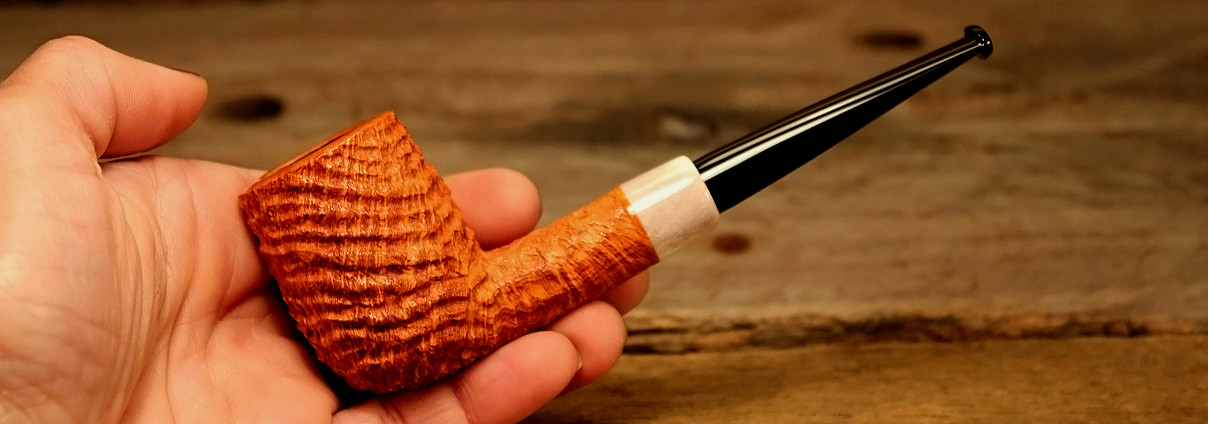
Interpreting classical models, exploring new aesthetic concepts and creating subtly organic forms are central to my creative process. Through techniques of striking contrast and sandblasting, I seek in each pipe a dialogue between precision and elegance.

I am Flávia Guilherme, a clinical psychologist with a Master’s degree in Social Psychology and a pipe artisan. Born in Belo Horizonte, I divide my time between psychoanalytic practice — where I accompany singular processes of transformation — and my studio, where I transform blocks of briar into unique pieces. From clinical listening to manual craft, my daily life is guided by life stories, analysis, research, colors, and textures.
The act of making pipes allowed me to access aspects of my subjectivity that I had not reached through either my personal analytic processes or my clinical and academic research. Encountering this craft also enabled me to investigate my past from another perspective and to understand how this savoir-faire is woven into my practice as a psychologist and researcher.
Ingenuity has been present in my life since childhood. My father spent his free time creating and carrying out projects to improve our home and give new life to things that seemed to have no further use. With him, I learned how to use tools, value manual work, and appreciate the possibilities of creating with my own hands. I remember a time when, during his vacation, he designed and built a built-in wooden wardrobe. I observed the entire process and, once it was finished, every detail: the drawers, the doors, the boiseries. The texture of the wood, along with its light brown tone, caught my attention. Everything worked perfectly and felt visually harmonious. I found it all deeply intriguing.
It is certain that my taste for creation was inherited from my ancestors. My paternal grandfather was a distinguished technician at the Morro Velho Mining Company, among other occupations, where he designed and created parts and technical solutions that improved the miners’ working conditions and surely contributed to the company’s progress during the 1950s.
Images on the right: pieces created and adapted by my paternal grandfather, Sérgio Rodrigues. Reference: Mineração Morro Velho. Sérgio Domingos Rodrigues. Operário Padrão, 1980. Personal collection.


A leap forward to 2017, the year I began carving my first pipes. Upon encountering this savoir-faire, I sculpted my very first piece: a classic model with a softly sandblasted finish. With a subtly organic character, my pipes draw inspiration from the classic shapes of the English and Danish schools, combined with a design that is both contemporary and distinctly my own.
On the left, an image of the third Billiard I created, finished with sandblasting.
In my artistic process, I enjoy interpreting classic models and am drawn to exploring new aesthetic concepts, expressing my subjectivity through a distinctive design. In subtly organic forms, I often give shape to my dialogue with nature — my other passion — and engage in experimentation with asymmetrical forms. This characteristic is visible in some of my creations, especially the model known as Volcano, which carries my personal signature.


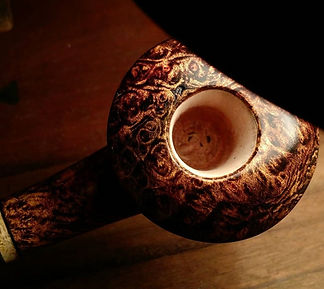
Sandblasting — a technique I adopted at the beginning of my career as an artisan and later refined through research and experimentation — has become a hallmark of my work. In smooth-finished pieces, I also developed my own contrast technique to highlight the grain of the wood. Through meticulous and delicate finishing, I transform each briar grain into something exceptionally beautiful and compelling, at times outlining soft, deep grooves, at others revealing striking contrast.
With specialized and precise engineering aimed at providing an excellent smoking experience, I explore harmonious proportions, meticulously highlighting each type of finish and incorporating diverse materials, such as metals, other fine woods, horns, and seeds — many of them native to Brazil, my homeland. To carve my pieces, the raw material is selected with rigor: I primarily use high-quality Italian briar blocks, properly dried and treated, sourced from renowned suppliers such as Mimmo Romeo and Manno Briar; occasionally, I also work with Algerian briar. The stems, essential both to the quality of the smoking experience and to the pipe’s longevity, are individually crafted from the finest German ebonite.
%2011_40_04_3afab00a.jpg)
In the act of carving pipes, I found the path between listening and creation. Within this savoir-faire, I discovered a new language, a way to give shape to my subjectivity. Through this practice, I connected with my ancestors and saw this savoir-faire transform into the dwelling place of my most subtle expression.
Currently, I am the only internationally recognized woman wood pipe artisan in Latin America, and I understand this journey as a possibility for opening paths toward the presence of other women in this craft.


